Showing posts with label Conservatives. Show all posts

Monday, 28 November 2011

The 2013 Ynys Môn Local Election results today

After some weekend number-crunching, here are my predictions for the 2013 local elections on Ynys Môn, assuming that the proposed new boundaries are accepted:

     Plaid Cymru:     11 seats
     Independents:     7 seats
     Labour:              6 seats
     Conservative:     5 seats
     Lib Dems:          1 seat

This would most probably result in a Plaid / Labour coalition, and the installation of Plaid's Bob Parry as Leader and Labour's John Chorlton as Deputy Leader.

Clearly the big winners would be Plaid Cymru, which would explain why Ieuan Wyn Jones promoted multi-member wards as the solution to Ynys Môn's local government problems during the Assembly election hustings. As far as I can see, Labour will not gain as many new seats as they suppose, and will in all probability only win two of the three seats on offer in the new 'Holy Island Port' super-ward.

A closer look at the new proposed boundaries throws up some interesting facts. Below is a map of the current electoral boundaries and the parties which hold them:

Anglesey's current local electoral map
Red: LAB, Green: PC, Blue: CON, Yellow: LD, Grey: IND
Click to enlarge

And this is a map of the new proposed boundaries overlaid on the above current map:

Yellow lines indicate the new proposed boundaries.
Number of Councillors returned by each new ward in brackets.
Click to enlarge

Although a number of current wards are cut into two, including Bodorgan, Llanfihangel Ysgeifiog, Llanfair-Yn-Neubwll and Pentraeth, only one of the current wards is to be split across three of the new wards: Bodffordd. Its almost as if the Boundary Commission was trying to ensure that somebody with a powerbase in Bodffordd could never get elected again...

Friday, 19 November 2010

The Druid Revealed

As ‘The Druid’ I have been commenting on the current affairs and politics of Anglesey since January this year when I set up this blog. I decided to start writing because it was plain to see that Ynys Môn was in decline: both economically and politically. Companies like Anglesey Aluminium, Eaton Electric, Menai Electrical, Peboc, and so on which had been operating on Ynys Môn for a generation were closing. On the other hand, Anglesey County Council had just been slammed by the Welsh Audit Office for a total breakdown in communications between councillors and officers, and then effectively taken into special measures by the Assembly Government. I didn’t want to just sit idly by so I started writing -- and for whatever reason it seems that what I wrote somehow struck a chord with other Ynys Môn residents. Before long the blog went from having zero comments, to perhaps one or two per post, to suddenly hundreds and hundreds of comments daily. It was an overwhelming experience, but it also proved to me -- and everyone else -- that there were literally hundreds of other Anglesey residents who were just as dismayed as I was with what was happening to our Island.

Of course not everyone agreed with my analyses and prescriptions, but everyone was happy to engage in mostly good humoured debates about topical issues concerning our Island. And, most importantly, people didn’t want to just criticise, they also wanted to propose solutions. Readers submitted intelligent and well thought out ideas in their hundreds to improve the Island, and it was these which ended up forming the core of the crowd-sourced ‘People’s Manifesto for Ynys Môn’ -- a labour of love for many of us. I can honestly say that my proudest moment since setting up ‘The Druid’ was not the day it was named as ‘Best Political Blog’ at the Wales Blog Awards, but the day I emailed the People’s Manifesto to Ieuan Wyn Jones, Albert Owen, and our 40 county councillors.

In addition to the People’s Manifesto there have also been a number of other key moments, and here is just a flavour:


...and many more.

You might wonder why there are two Albert Owen stories above, but none about Ieuan Wyn Jones? The reason is this: for whatever his faults Albert is at least committed to Anglesey and engages with residents openly and quickly. Indeed when I sent out the People’s Manifesto, the very first reply I received was from Albert. In contrast I never heard anything back from Ieuan Wyn Jones -- and this is also true whenever I have looked to write about him on this blog: there’s literally nothing to write because his engagement with his own constituency is so slight. And that is not just my opinion -- I have now heard the same sentiments repeated to me by many, many Islanders. As we all know, Ieuan Wyn currently has four jobs:

  • Deputy First Minister,
  • Minister for Economy and Transport
  • Leader of Plaid Cymru, and
  • AM for Ynys Môn

There is no doubt in my mind that he prioritises his attention and energies on his ministerial and Plaid Cymru responsibilities at the expense of his most important job: being our AM. As officially the poorest place in the UK, I believe that Ynys Môn can no longer afford the luxury of an AM who's first priority is not looking after his own constituency.

Anyone who has read this blog for any period of time will know that my political views are quite clearly conservative - something I have never tried to hide. Accordingly, and after a great deal of thought, I decided that I would put myself forward for selection as the Conservative candidate for next May’s Assembly elections -- not because I particularly want to be a politician, but because I have a passion for my home Island and want to do something to help halt the decline. I’m happy to announce that last night I was selected as the Welsh Conservative candidate for Ynys Môn and will take on Ieuan Wyn Jones in next year’s Welsh Assembly elections.

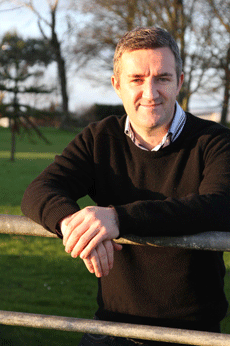
Paul Williams
a.k.a. "The Druid"
Therefore it is now time to cast aside my cloak and reveal my identity. My name is Paul Williams and I was born, brought up, and educated on Ynys Môn. My family have farmed the Island for centuries and I spent my younger life on the family farm just outside Llangefni (before we converted it into the very successful Tafarn Y Rhos pub). I attended Ysgol Gyfun Llangefni and my first paid job was in the Welsh Country Foods abattoir in Gaerwen. Like many of my peers I left Anglesey to attend University and picked up two degrees including a Masters in Japanese, which I now speak fluently. I went on to have considerable international business experience: I spent six years working in Tokyo, Japan, and a further six years in Frankfurt, Germany, where I was appointed to a very senior European marketing position for one of the World’s largest consumer electronics firms. I also however have experience of business on a smaller scale: three years ago, just before the credit crunch, I decided to set up my own small consultancy firm and therefore weathered the storm of the recession as a small businessman and learned intimately the problems and pressures facing small businesses all over the UK but particularly here in Anglesey. I currently live in Rhostrehwfa with my longterm girlfriend.

As the Welsh Conservative candidate, in addition to being guided by the People's Manifesto, I will be focussing on the following key points:

  • championing a private sector led economic recovery on Anglesey. Over a relatively short period of time Ynys Môn has seen the closure of several of its largest firms and the loss of over 2,100 private-sector jobs, according to a study by the University of Wales. Small and Medium Enterprises (SMEs) are the biggest job-creators in our economy, yet Ieuan Wyn Jones’s Economic Renewal Programme has slashed the amount of support available to these smaller firms. I will champion and support our SMEs to set-up and expand by recognising the value of these embryonic companies and their potential to grow and create employment.
  • Support a smarter ‘Energy Island’ concept. I will provide full and unequivocal support for the development of Wylfa B. However for the ‘Energy Island’ concept to fully benefit Anglesey we need to be more than just a ‘site’ for nuclear reactors and water turbines. As such I will champion the creation of an Energy Technology Park on the Island and ensure that the skilled workforce needed for the power station and its construction are sourced locally.
  • Support the recovery of Anglesey County Council. The political problems at Anglesey County Council have created an environment of instability and indecision which is not conducive for business investment or development – particularly due to the absence of a clear planning policy framework.
  • Champion Agriculture and Tourism on Ynys Môn. Between 1997 and 2007, the economic contribution of agriculture to the North Wales economy fell by 67 percent, compared to an overall UK decline of just 7 percent. Equally, in terms of tourism, Anglesey does not suffer from a dearth of places to visit, it suffers from a lack of imagination in marketing itself. I will champion and support both agriculture and tourism on Ynys Môn.
  • Defend Anglesey from disproportionate cuts. I recognise the need for the government to reduce the structural deficit, however I will defend Anglesey from any disproportionate or unfair cuts to policing, health, education and other frontline public services.
  • To be a dedicated AM for Ynys Môn. It is clear that the Ieuan Wyn Jones’s Leadership of Plaid Cymru and ministerial duties are compromising his ability to give Anglesey residents a much needed and dedicated voice in Cardiff Bay. I pledge to be an excellent and dedicated AM for Ynys Môn.

As for this blog: it will continue. As far as I am concerned nothing has changed -- I am still the same person I was before becoming a candidate -- and I will continue to write about matters which effect both Ynys Môn and Wales as a whole. Like you I want to see what's best for this Island.

Paul Williams / The Druid

P.S. Some of you may have noticed that someone called Alwyn Rowlands, apparently the Chair of the Anglesey Labour Party, has recently taken to writing angry letters to the Daily Post and Anglesey & Holyhead Mail demanding that "if [the Druid] wants to become involved in politics, then come out and debate it out in the open with the rest of us". Well, Alwyn, here I am.

Saturday, 8 May 2010

Ieuan Wyn Jones and next year's Assembly elections

My record in predictions hasn't been too good this week so lets treat this post as conjecture rather than prediction...

Following the dramatically reduced Plaid Cymru vote in Ynys Mon this week, a pretty interesting discussion has been going on in comments below this post regarding whether Ieuan Wyn Jones will become vulnerable in his home seat at next year's Assembly elections. After all Plaid's candidate, Dylan Rees, polled a staggering 2,000 votes less than Eurig Wyn did five years ago - whilst the Tory candidate polled 4,000 more votes. Is this purely down to the unpopularity and unsuitability of the Plaid Candidate and the collapse of Peter Roger's vote? Possibly - but Plaid's vote throughout the whole of North Wales was slightly down and even the popular Elfyn Llwyd saw his vote drop by 6%. Perhaps we are witnessing a more fundamental change in North Wales which goes beyond the unpopularity of one candidate.

So what does this mean for Ieuan Wyn Jones at next year's Assembly elections? Firstly lets take a look at the Assembly results in Ynys Môn to date:

click to enlarge

Ieuan Wyn Jones won the inaugural 1999 election with more than 50% of the vote and the Druid remembers the seas of green in Anglesey pubs on the evening of the election. Since then IWJ's majorites have been more muted and hovered around the 10,000 mark - but it has to be noted that the turnout for the Assembly elections has also tumbled since 1999, probably because a lot of voters got bored after the novelty of the first election. Labour's vote has progressively declined at each election, and the Lib Dem vote completely collapsed in 2007. But look at the Conservative figures: up in 2003, and was arguably up again in 2007 and almost neck-and-neck with IWJ's if you add the Tory and Peter Rogers vote together.

Ah, you say, but Peter Rogers draws support from both the Tories and Plaid Cymru so you can't just add them together. Indeed that has always been the assumption (Eurig Wyn blamed his loss in 2005 on Peter Rogers), but lets take a look at this week's results: Despite Peter Rogers' personal vote falling by 2,000 votes it doesn't seem any of them went to Plaid Cymru - meaning that Rogers supporters must be mostly centre-right voters who, for whatever reason, preferred Rogers to the Conservative or UKIP candidates.

So, what will happen if Peter Rogers decides not to stand at next year's Assembly election? All things being equal it looks like the Conservative and Plaid Cymru vote could be very, very close indeed.

But here's the thing - all things won't be equal. In my opinion there will be four factors (three certain, one conjecture) which will make next year's Assembly election much more different than the last two:

  • Next year Ieuan Wyn Jones will have to fight his first ever election as an officeholder and member of the Government. He is the First Deputy Minister of a Labour-Plaid coalition and he will have to fight on his record - a much more difficult prospect.
  • The coming Assembly powers referendum will raise awareness of the importance of the Assembly and how it has more influence over the everyday lives of Welsh voters then Westminster - accordingly we can expect an increased turn out for next Year's election.
  • Here comes the conjecture: suppose a Cameron led coalition or minority government (neither certain yet) decides to drop Cheryl Gillan and appoint Glyn Davies as Welsh Secretary instead. Glyn has just overturned Lembit Opik's 7,000 vote majority in Montgomeryshire and is a naturally charismatic, popular and respected dyed-in-his-roots Welsh (and Welsh speaking) politician. What's more is that he is also widely respected amongst amongst Plaid Cymru supporters (see here). If Glyn Davies was to achieve the same kind of ubiquity in the Welsh media as Peter Hain has in the same role then it would undoubtedly provide a powerful boost to the Conservative vote - especially in constituencies like Anglesey where it appears we are already seeing something of a surge in Conservative support.
  • The final point which will set next year's Assembly election apart from previous ones will be by how much Wales will be effected by the Public Sector cuts to come - and to what extent they will be blamed on the incoming Westminster government, whatever shape that takes. Though interestingly if it is a Con-Lib coalition in Westminster and a Lab-Plaid coalition in Cardiff, none of the parties are going to be able to escape some involvement in the cuts.

So, there you are - no predictions, just some conjecture and food for thought for you.

Monday, 19 April 2010

Albert Owen struggling with reality once again

        
The Druid's spies in Beaumaris tell him that during Friday night's MENCAP-sponsored election hustings on disability issues held in the Beaumaris Leisure Centre, our sitting MP Albert Owen was once again struggling to come to terms with reality.

Apparently following an introductory statement by the Conservative candidate, Anthony Ridge-Newman, which touched on the fact that Anglesey is poorest county in the UK, Albert Owen stormily interjected:

"Lets get one thing straight: Anglesey is not the poorest county in the UK and I'm fed up of people running this Island down"

This is the kind of reality-busting outburst we have gotten used to from Albert (see here, here and here for examples) who would clearly prefer us to believe him rather than the evidence of our own eyes (or even the National Statistics Office). So for the benefit of Albert Owen, here is the truth about Anglesey:

  • A GDP per head of only half of the UK average thus making it officially the poorest county in the UK according to the Office of National Statistics (pdf);
  • Equivalent to some of the poorest parts of Poland in a recent OECD report;
  • The lowest GVA per head in Wales at just 53% of the UK’s average; 
  • A dwindling private sector following the closures of Anglesey Aluminium, Octel, MEM/Eaton, Peboc and many others;
  • A rising unemployment rate currently standing at 5.8%; 
  • An economic inactivity rate of 25.1%; 

So, Albert, please understand that pointing out the facts is not "running this Island down". Running the Island down is what happens when our elected representatives (including our MP, our AM and our Councillors) neglect the Island due to either laziness, incompetence, self-interest, mal-administration or any combination of these.

As I have written before: the problem with this kind of fantasy politics from Albert is not only is it deceptive towards voters, it also prevents the formulation of good policy. If you are so invested in your fantasy and refuse to accept the reality, then it follows that you cannot make policy to solve real problems. And that is a tragedy not only for the Albert Owen but for us all. 
         

Wednesday, 14 April 2010

Tea Towel of the Day

  
Yes, not only does the Druid do "Quotes of the Day", "Photos of the Day", and "Tweets of the Day" - I also now do a nice line in "Tea Towels of the Day" too.

BBC Wales's Betsan Powys spotted it first, but it appears questions are being asked of the Welsh Conservatives about why Anglesey isn't "all in this together" with the rest of the country on this tea towel (left) they are selling.

Does this mean Anglesey is to be spared the cuts and tax rises we all know are coming after the election to reduce the immense deficit this Labour government has racked up? Yeah, thought not.
       

Friday, 9 April 2010

Is this going to be the most economically illiterate election ever?

        
I don't often write about national politics as there are already enough blogs out there doing that - however the levels of economic illiteracy being shown by both politicians and media is staggering.

National Insurance is made up of two components: one part is paid directly by employees (11% of your salary) and one part is paid by your employer (currently 12.8% of your salary). Accordingly if you are paid £100 a week by your employer - the actual cost per week of employing you for the employer is really £112.80 as the employer also needs to pay a NI contribution on your behalf to the HMRC. This doesn't matter so much in small companies, but in large companies  which employ hundreds or thousands of employees (i.e. the kind which are currently writing letters in support of not raising the employers contribution to NI) a 1 percentage point increase can add up to a heck of a lot. There is no room to question that this is a tax on employment - it patently is.

Labour then attack the Tories by saying it is impossible to cut £6 billion (the amount of 'lost revenue' from not putting up the employer's contribution to NI by 1% point) from the government's budget without affecting frontline services. This year the Government is budgeting to spend £655 billion. £6 billion is therefore 0.9% of this total. Its ridiculous to say that you can't reduce this budget by less than one percent without endangering frontline jobs.

Labour then say you can't afford to take £6 billion out of the economy at a time like this. Firstly it is not being 'taken out of the economy' - its actually just not being taxed out of the productive side of the economy and eaten up by government. The money remains in the hands of companies who can use it to boost their profits and thus potentially hire more employees, spend it on developing new products, etc. etc. Secondly, the UK's GDP in 2010 is estimated to be about £1,200 billion. The so called £6 billion 'cut' is only 0.5% of that total. Even if that sum was to be magically 'taken out of the economy' (which it isn't) it wouldn't make any difference.

How this can actually be a 'debate' mystifies me.

And check out this quote from Robert Peston, the BBC's so-called Business Editor:

"the Conservatives would also argue that the private sector is more efficient at generating the revenues and wealth that pay for public services than the public sector."

The Conservatives would 'argue' that because its the truth. Only the private sector actually 'creates wealth' which is then taxed by the government to provide public services. Its not a question of which sector is more 'efficient' at doing it as the public sector does not create any wealth.
    
UPDATE: This post deserves to be read in full to put the Labour and Conservative proposed cuts into perspective.
  

Sunday, 21 March 2010

BlogMenai, Hung Parliaments and Statistical Gobbledegook

  
Mandy Rice-Davies: "Well he would, wouldn't he?"

BlogMenai has taken issue with the Druid's recent post analysing Plaid Cymru's claims that in the event of a hung parliament they could hold real influence. In my post I relied on the polling data available on the non-partisan poll aggregating site electoralcalculus.com and concluded that, in the event of a hung parliament with the Conservatives the largest party but short of an absolute majority, there is very, very little likelihood that the Conservatives would ever need to rely on Plaid Cymru votes - thus contradicting Plaid's central argument to voters in the run up to the General Election. You can read it all here.

BlogMenai - an openly Plaid Cymru supporting blog - completely dismisses the Druid's conclusions ("well he would, wouldn't he?" as Mandy Rice-Davies might have said) and goes on to claim that I rely on statistical gobbledegook and that the case I made is false for the following reasons:
  1. I have used polls selectively to support my point and ignored those which don't fit in with my preferred conclusion; and
  2. that I have used outdated polls.
To prove his point, BlogMenai then lists the results of a number of polls (without any attribution) which show a much smaller gap between the Conservatives and Labour than an aggregate of the polls of the month ending March 4th on which my post relied (my post was made on March 9th). BlogMenai then goes on to state - again without any supporting evidence - that some of the polls he lists point to Labour being able to form a coalition government with the support of just SNP and Plaid Cymru alone without needing the Lib Dems at all.

My reply

BlogMenai is certainly right to say that the polls have tightened but I'm afraid the claim that I somehow 'cherry picked' only those polls which supported my argument is patently false. The Druid wrote the post on March 9th, in response to a letter by Dylan Rees in the Daily Post the previous day, and based it on the non-partisan polls aggregator electoralcalculus.com which on the day of writing was aggregating polls for the month ending March 4th (electoralcalculus.com is only updated once or twice a month). Now electoralcalculus.com aggregates ALL the polls over the stated period so BlogMenai's claim that I somehow maliciously chose only those polls which supported my argument is so obviously false to be laughable.

But its worse than that. Whilst accusing your humble Druid of only selecting polls which support his argument, BlogMenai then goes on to (a) disregard the results of Angus Reid polls because (he claims) they are "untested in the UK" and "give Labour a much, much lower share than other conventional pollsters" and (b) makes his unfounded conclusions on the basis on a selection of polls of his choosing - the very definition of selecting polls to suit one's argument. This is particularly ironic considering BlogMenai piously concludes his post by saying that although he may be biased towards Plaid Cymru he would never stoop so low as to use statistics selectively to make a point. Really? It doesn't look that way.

That said BlogMenai is right to say that the polls are tightening so lets crunch the numbers again using the latest aggregated numbers from electoralcalculus.com - those for the period February 5th to March 18th (although I'm sure our cherry-picking friend BlogMenai will complain once again that they aren't recent enough or that a selection of polls chosen by himself show an even smaller Conservative lead):


So with these more recent polls, electoralcaculus.com predicts exactly the same number of seats for Plaid and the SNP as previously:

Plaid Cymru - 5 seats
SNP - 7 seats

Therefore between them Plaid and SNP are still likely to control a block of just 12 seats. Labour, based on electoralcalculus.com's same calculations would win 262 seats - i.e. 64 seats short of an absolute majority. In this case Labour would need the support of the Lib Dems (53 seats) and both Plaid and SNP (12 seats) together just to get a majority of just one seat. Doesn't sound anything like BlogMenai's glib statement that Labour can form a coalition government with the support of just SNP and Plaid Cymru alone, does it? (Incidentally, BlogMenai also fails to explain how exactly Plaid Cymru and the SNP will be able to work together on reforming the Barnett Fomula when even Plaid's Dafydd Wigley has noted that they would be working at cross purposes and would need to hold separate negotiations with the Tories. You didn't mention that point in your critique of my post, did you, BlogMenai. Didn't it fit in with your argument perhaps?)

Anyway, returning to the figures for a moment: the Conservatives (302 seats) are still able to form a coalition with just the Lib Dems (53 seats) - giving them a comfortable majority of 29 seats (whether they call it a formal coalition or not). So still no need for Plaid's votes and still no extra influence for Plaid in Westminster.

The Druid's political allegiance

BlogMenai's criticisms don't stop there however. He goes on to say that the Druid must be a Tory because I only attack Labour and Plaid Cymru. I don't know how many times I have to write this but the Conservatives have not had any influence over Anglesey since 1997 -- 13 years ago. What's the point of attacking them? What I'm concerned with is the CURRENT state of Anglesey and those who bear political responsibility for it NOW. And, like it or not, the facts are:

  • Ynys Môn has now been represented by Plaid Cymru's Ieuan Wyn Jones as either MP or AM for the past 23 years
  • The UK has had a Labour government in Westminster since 1997 and Ynys Môn has had a Labour MP in the shape of Albert Owen since 2001
  • The Welsh Assembly has been governed by Labour since 1999 until the emergence of a Labour/Plaid Cymru coalition in 2007

Therefore, BlogMenai, the truth is that Ynys Môn has been administered at some level by Labour and Plaid Cymru for almost quarter a century, yet you think that as an Anglesey resident I should somehow be directing my fire on the Conservatives for the Island's woes? Anglesey is now officially the poorest county in the UK - the very definition of political failure - and BlogMenai's partiality to Plaid Cymru is obviously blinding him to the conclusion that Ieuan Wyn Jones HAS FAILED the residents of Anglesey.

The Druid's Challenge to BlogMenai

Anyway, the polls will no doubt continue to change between now and the general election so I will continue to crunch the poll numbers once a month and if it ever gets to a point were statistically the polls point to Plaid Cymru having any real influence I will plainly write so here. Furthermore if following the election there emerges a Labour coalition with just Plaid Cymru and the SNP - as BlogMenai predicts - then I'll eat my 'wisg las'. If on the other hand such a coalition fails to materialise then I look forward to a full apology from BlogMenai. Okay?

Finally my message to BlogMenai readers is this: if you want to read about the world as Plaid Cymru would dearly like it to be - go ahead and read BlogMenai; if, however, you want to read about the world as it really is, read the Druid.

UPDATE (23 March): BlogMenai has now responded to this post and you can read his reply (in Welsh) here. My response is coming soon...
  

Thursday, 11 March 2010

Should Anglesey be 'paid' to host the Wylfa power station?


There has been much fuss regarding the establishment by the government of the Infrastructure Planning Commission (IPC), a body set up to fast-track planning applications for so-called "nationally significant infrastructure projects" so as to save them being held up or halted by unwilling local authorities and public inquiries. This is important to Anglesey residents as potentially the decision to grant planning permission to a second nuclear reactor at Wylfa could be adjudicated by this body.

However, the Conservatives - who have every chance of forming a government in May - are pledged to abolish the IPC on the grounds that it is anti-democratic insomuch that it transfers certain planning decisions away from elected local authorities and ministers and instead puts them in the hands of unelected appointees. Under Conservative proposals the decision therefore whether to grant planning permission to Wylfa B will be devolved back to the Secretary of State.

Frankly neither of these processes are entirely satisfactory as the ultimate decision on whether Wylfa B goes ahead or not will be taken a long way from the people of Anglesey - who will ultimately have to live with the presence of the new reactor. Now, the Druid is personally 100% behind Wylfa B and believes that the jobs created by its construction and operation will be crucial to the future prosperity of the Island - however its also fair to say that Anglesey, the poorest county in the UK, is 'taking the strain' in hosting a critical piece of the UK's national energy infrastructure which is unwanted elsewhere and should therefore be rewarded above and beyond the jobs which the plant will generate.

The maverick Tory MEP, Daniel Hannan may not be to everyones taste but he is always a thoughtful and original political thinker. In his Telegraph column this week he describes how some US States have come up with a very interesting way of incentivising local communities to 'host' unpopular but necessary state-wide installations such as power stations or incinerators. He writes:

"The answer here, surely, is to allow local communities to put a price on accepting them. Let us say that a county wants an incinerator, and identifies a dozen potential sites. It should then invite the local authorities from each affected area to submit a sealed bid, stating how much it would want in return for accepting the facility. The one to submit the cheapest bid would win.
The council could then spend the fee as it wished: it could give residents a tax rebate, write them cheques, or use the money for something else. A similar system works successfully in a number of US states. Apart from anything else, it would encourage local people to weigh the costs and benefits, instead of automatically opposing every proposal on grounds that it is being forced on them from outside. Tell a group of people that they must take a mobile phone mast, and they will understandably protest. Invite them to sell permission for a site … and they might take a different attitude."

Obviously one can foresee a lot of problems with this approach which would need to be ironed out - but to the Druid it makes a lot more sense than the current systems outlined above.

And imagine what a huge difference a significant annual payment for hosting Wylfa B could make to the whole island - especially if it was invested wisely by the council in an economically sustainable way such as, for example, reducing rates for local businesses thereby both boosting employment and incentivising new businesses to setup on the island. Sounds good to me.
   

Tuesday, 9 March 2010

Will Plaid Cymru have any influence in a Hung Parliament? (Updated)

     
In a letter in yesterday's Daily Post, Plaid Cymru's PPC for Ynys Môn, Dylan Rees, rehearses Plaid's most critical message to the Welsh voters for the forthcoming election: that even though there is no chance of Plaid Cymru actually winning the general election, a vote for Plaid Cymru in the Westminster election - as opposed to the Assembly elections - will not be a wasted vote. This is how Dylan Rees makes the argument:

[T]his general election is very likely to produce a hung parliament. In that event Plaid Cymru will have an even more influential role to play as it seeks to win a fairer deal for the people of Wales.

Taken at face value this does indeed sound plausible. If either of the two large parties fail to win a majority in the election they will seek to form a coalition government with some of the smaller parties such as Plaid Cymru. These smaller parties will then give their support subject to the eventual coalition government agreeing to the smaller parties terms - in Plaid Cymru's case this is likely to include:

  • an overhaul of the Barnett Formula to give Wales a more equitable settlement
  • the raising of pensions by 30% for Welsh OAPs over the age of 80

As I said: it sounds plausible - but is it likely? Lets take a look at the numbers...

Electoral Calculus

Following the boundary changes the House of Commons will, after this general election, increase from 646 to 650 seats. Accordingly for any party to obtain an absolute majority they would need to win 326 seats. Using the electoralcalculus.co.uk's mathematical analysis of recent polls, this is the result which they predict:

click to enlarge

So, based on the polls for the month ending March 4th, they predict that the Conservatives will win 315 seats - just 11 short of a majority. How many seats are Plaid Cymru likely to win? Well, for the sake of consistency lets use the same electoralcalculus.co.uk's calculations which predict that Plaid Cymru will hold Carmarthen East and Dinefwr, Dwyfor Meirionydd and gain Arfon (part of the existing Caernarfon constituency currently held by Plaid's Hywel Williams), Ceredigion and Ynys Môn. This will give Plaid Cymru 5 seats in Westminster. So its clear that under these current predictions Plaid Cymru's support alone will not provide enough seats for the Conservatives to reach a majority. Therefore both the Conservatives and Plaid Cymru would also need the support of another party - for example the SNP.

There has been much talk of a 'power pact' between the SNP and Plaid Cymru in the event of a hung parliament. Politicalcalculus predicts that SNP will will have 7 MPs after the election, giving SNP and Plaid Cymru together a total of 12 seats which would give a potential Conservative-Plaid Cymru-SNP coalition government a one seat majority. But the reality is that such a coalition would not work because:

  • The SNP's obvious demand for the complete independence of Scotland would be a price too high to pay for the Conservatives, who would simply prefer to go for a second general election
  • According to Gerry Holtham, whereas the Barnett Formula under-funds Wales by about £300 million a year it over-funds Scotland by a whopping £4.2 billion a year. Any adjustment to give Wales a more equitable settlement would necessarily mean Scotland receiving less - and the SNP will never agree to that. Even Dafydd Wigley has acknowledged this stating in effect that they’d be working at cross purposes and should hold separate negotiations with the Tories
  • Even with the probable support of the UUP and other Unionist Parties, the slim majority of a Conservatives-SNP-Plaid Cymru-Ulster Unionist coalition would quickly become unworkable in practice as each of the minority parties would effectively be able to hold the new government to ransom.

The only conclusion we can draw from the above is that even if it is mathematically possible for Plaid Cymru and the SNP to form a coalition government, the practicalities would make it unworkable. It is simply far more likely that the Conservatives would form a coalition with the Lib Dems, who with a predicted 50 seats, would give a Conservative-Lib Dem coalition a much more comfortable 39 seat majority. In such a case there would be no need for Plaid Cymru's support.

Conclusion

The above is just one scenario based on electoralcalculus.co.uk's current predictions. The only real chance for Plaid Cymru to wield any significant influence would be in the event that the Conservatives fall short of a majority by a very, very small margin - one seat for example - whereby Plaid Cymru's support alone would be sufficient to get a majority. What are the probabilities of that? Helpfully electoralcalculus.co.uk also provides the mathematical probabilities of a number of outcomes:


So the chances of there being either a Conservative or Labour majority or a Lib-Dem coalition with either of those two parties is effectively 99%. Accordingly, the mathematical chances of Plaid Cymru forming a coalition government with the Conservatives - and thus seeking a so-called 'fairer deal' for Wales - is less than one percent.

Accordingly, if you are an Ynys Môn voter, the only reason to vote for Dylan Rees is if you think that he will be a good constituency MP with the experience and ability to lead Anglesey's economic and social recovery (the Druid personally does not believe he is capable and has set out his reasons in detail here). If however you only vote Plaid Cymru in the hope that they will be able to wield influence in a hung parliament then you have a 99% probability of wasting your vote.
    
UPDATE: Plaid Leader Ieuan Wyn Jones has made clear that in the event of a Hung Parliament, Plaid has no intention of joining a formal coalition - rather, as the always well informed Dylan points out in comments, they would seek concessions from the Conservatives for their support in key votes. He cites the example of Plaid Cymru exacting compensation for Welsh quarrymen from the Callaghan government in 1979 as a historical precedent. Unfortunately this doesn't invalidate my argument as the probabilities of the Conservatives needing to rely on Plaid Cymru for any particular vote are still remote. The fact is that the only circumstance when the Conservatives would need to bargain with Plaid Cymru for their support would effectively be when their coalition with the Lib Dems had collapsed, anyway leading to new election. To prove this point, the below graphic shows that coalition governments (red line) in the UK tend not to last very long:


Furthermore, despite the tightening poll figures, the betting markets are still overwhelmingly predicting a Conservative majority. Therefore as I wrote above: if you are an Ynys Môn voter, unless you think that Dylan Rees would be a good constituency MP, any vote for Plaid Cymru will in all probability still be a wasted vote.
      

Monday, 8 March 2010

Albert Owen: 'Conservative hypocrisy' behind closure of Anglesey Aluminium

  
Regular readers will know that the Druid has often discussed at length the reasons behind the closure of the Island's largest private employer, Anglesey Aluminium (here and here, for example). Ynys Môn's Labour MP, Albert Owen, however has his own theory which he disclosed in a recent interview:

"We [the Labour government] came up with a package to save them, worth £48 million, but they turned it down," he shrugs. "It's Conservative hypocrisy - they don't believe in subsiding business."

I don't want to write a repeat of yesterday's post, but what exactly did 'Conservative hypocrisy' have to do with the closure of Anglesey Aluminium? Perhaps Albert Owen hasn't noticed that his Labour party has been in power for the past 13 years and, as far as I am aware, was certainly still in power in September last year when the plant closed its doors.

For the benefit of Albert Owen: the organisation which doesn't believe in subsidising business is actually the European Union, which bars European governments from creating unfair competition by injecting public funds into private industry. Accordingly, when the Nuclear Power station at Wylfa was acquired by the Government's Nuclear Decommissioning Authority (NDA), the NDA's lawyers had to inform Anglesey Aluminium that they would no longer be able to supply it with the cut-price electricity on which it depended as that would constitute 'state aid' under EU law. Indeed, this was made clear by the NDA in January 2009 when its spokesman said this:

"There’s been no breakdown in the relationship between ourselves and Anglesey Aluminium but we have explained to them the situation. We cannot extend the current contract with them due to new European legislation on providing subsidies to private companies.”

So, Albert, please do explain how 'Conservative hypocrisy' or their stance on subsidising businesses in anyway contributed to the closure of Anglesey Aluminium - with, let me add, a loss of at least 450 well paid direct jobs and an estimated 240 others through indirect and induced effects. 

In order to further underline his complete abdication of responsibility, Albert Owen concludes his interview with these words on the closure:

"I don't think I'm going to take as big a hit on that as my opponents think."

Is this serial fantasist, clearly more concerned with his own political survival than the welfare of his constituents, really the MP that Ynys Môn deserves?
    

Sunday, 7 March 2010

The Druid gets a bad review & my reply

     
The Druid returned home to Môn from his travels last night to find this comment:


Ouch! Dishonest and insincere, am I? Permit me to reply:

My dearest La Pasionara, its strange that you would think that "fighting for Ynys Môn" should mean bashing the Conservatives or Peter Rogers. As you may have noticed Anglesey hasn't been represented by a Conservative MP since 1987 -- 23 years ago -- nor has there been a Conservative administration in the UK since 1997 -- 13 years ago. What I'm concerned with is the CURRENT state of Anglesey and those who bear political responsibility for it NOW. And, La Pasionara, like it or not, the facts are:

  • Ynys Môn has now been represented by Plaid Cymru's Ieuan Wyn Jones as either MP or AM for the past 23 years
  • The UK has had a Labour government in Westminster since 1997 and Ynys Môn has had a Labour MP in the shape of Albert Owen since 2001
  • The Welsh Assembly has been governed by Labour since 1999 until the emergence of a Labour/Plaid Cymru coalition in 2007

Therefore, La Pasionara, the truth is that Ynys Môn has been administered at some level by Labour and Plaid Cymru for almost quarter a century, yet you think that as an Anglesey resident I should somehow be directing my ire on the Conservatives or Peter Rogers for the Island's woes?

Speaking of which, lets remind ourselves of what exactly the Island's woes are:

  • Anglesey is the poorest county in the UK with a GDP per head of only half of the UK average according to the Office of National Statistics;
  • Anglesey has the lowest GVA per head in the UK at just 53% of the UK’s average; 
  • Anglesey is poorer than some of the poorest parts of Poland according to a recent OECD report;
  • Data for full-time employees show that average earnings in Anglesey were approximately £396 per week in 2007, compared with £415 per week in Wales and £456 per week in the UK. It should also be pointed out that gross average earnings were distorted by wages paid to employees at Wylfa and Anglesey Aluminium, which are substantially higher than other wages in the area. 
  • But we don't have to worry about Anglesey Aluminium distorting average earnings on the Island anymore because it has been forced to close wiping out at least 450 jobs directly and an estimated further 240 jobs through indirect and induced effects;
  • In addition Anglesey has also lost Octel in Amlwch, Eaton Electric in Holyhead, Peboc in Llangefni and Welsh Country Foods has restructured in Llangefni and Gaerwen losing thousands of more jobs;
  • A rising unemployment rate currently standing at 5.8% and economic inactivity rate of 25.1% - even before most of the above companies closed; 
  • Remarkably farming in North Wales has fared even worse than the economy. During the period 1997 to 2007, the economic contribution of agriculture to the North Wales and Anglesey economy fell by a staggering 67% compared to an overall UK decline of just 7%;
  • On top of all this, Anglesey County Council is poorly managed, riven with infighting, and planning on raising Council Tax by 15% over three years - though with almost everyone apart from Council workers out of a job, the Druid wonders who is going to pay it.

So lets be clear: its not just that the situation on Anglesey is just a little rubbish - the situation on Anglesey is arguably the WORST in Wales and in the UK as a whole. Thats what drives the Druid.

Yet despite the situation being as bad as it is, both Labour and Plaid Cymru - responsible for Anglesey for most of the last quarter of a Century - refuse to accept any portion of the blame. Indeed as recently as just two weeks ago on the Politics Show special edition on Anglesey, when asked whether Labour was responsible for any of the problems on Anglesey, Albert Owen replied:

"No, I came into politics in the 80s when it was a damn sight worse than it is now, we have to be honest about that. There was mass unemployment and mass depopulation in the 80s and 90s. Its certainly a lot better now."

Got that? Nothing to do with Labour at all - and anyway things were much worse under those nasty Tories 30 years ago... Unbelievable. As I've pointed out before, the 80s were rough but all of the companies which have closed in the last couple of years managed to survive the 80s, and are only closing now. That must tell us something about the current business environment and the policies which have been implemented from Westminster and Cardiff for the past 13 years. Plus when you are now officially the poorest place in the UK things by definition can't have been any worse - or at least have not improved.

So, La Pasionara, if you would like to explain to me why I should attack the Conservatives and Peter Rogers more than Labour and Plaid Cymru for the current problems in Anglesey I'm happy to listen to your arguments. Otherwise, change your ID as frankly you're giving Dolores Ibárruri a bad name.
    

Friday, 5 March 2010

New Poll: Labour's Albert Owen to hold Ynys Môn in General Election?


I don't know - you go away for five minutes and YouGov publishes a new Wales-only voting intention poll...! Accordingly, for your benefit, the Druid has temporarily interrupted his short trip and crunched the regional numbers to find out what is happening in North Wales. So here is a graph showing the transition of support for the main parties in the North since the General Election in 2005 up to and including today's latest poll:


The big news is that Plaid's Support in the North has unexpectedly and dramatically nosedived 7 points since the last poll in mid-January, putting them on just 10% - even lower even than the Lib Dems. Of course the sample size in North Wales of around 250 people is quite small so there is room for error but, still, 7 points is a large drop. The Druid would guess that it may be due to Plaid Cymru's ridiculous pensions pledge being quite correctly seen as misleading fantasy politics - which as the Druid said at the time makes Plaid look like not a serious party.

The other news is that at the expense of Plaid Cymru both the Labour and Conservative vote is up. What does this mean for the General Election result in Ynys Môn? Using exactly the same formula which the Druid used for the last poll, the change on the 2005 General Election results are shown below (bottom row):


Of course the situation across the whole of North Wales is not homogenous, but these results are the best guide we have. Therefore, again assuming that Peter Rogers does not stand (although there is no evidence that this is the case) and his support swings behind the Conservatives, this is what the new polling data predicts for Ynys Môn:


The result: A Labour hold for Albert Owen with Plaid and the Conservatives fighting it out for second place with just a couple hundred votes between them. 

I'm going to be looking into all these latest YouGov figures in more detail as soon as I get back to Anglesey, but in the meantime it looks like 'squeaky bottom time' for Plaid's Dylan Rees who until recently was widely thought (by himself included) to be a shoo-in for the seat.
   

Tuesday, 2 March 2010

The BBC 'devolution' poll - what makes North Wales different?

  
The BBC has carried out a poll to gauge the level of support in Wales for the Welsh Assembly. The headline results, with only 13% of respondents wanting the Welsh Assembly abolished, show how much Welsh public opinion has swung behind the concept of some kind of devolved government in Wales over the past 30 years:

click to enlarge

As the Druid is a 'Gog Blog' it is always interesting with all-Wales polls to see how the opinions of North Wales residents differ from those of Wales as a whole.

North Wales: pro-Assembly, anti-Westminster

North Wales residents are much more pro-Assembly and anti-Westminster than any other part of Wales: only 17% of North Wales respondents thought Westminster should have the most influence over Wales - much less than the 25% of West & Mid Wales respondents or 27% of SE Wales respondents. Similarly 69% of North Wales respondents thought that the Welsh Assembly should have the most influence over Wales - more than the 63% of West & Mid Wales respondents and just 57% of SE Wales respondents. Furthermore, just 6% of North Wales respondents agreed with the statement "Wales should remain in the UK and the Assembly should be abolished", compared with 12% and 16% of West & Mid Wales and SE Wales respondents. This is actually quite surprising as it has commonly been thought that there is a resentment in North Wales against the Assembly being located in a 'distant' South Wales - this is obviously no longer the case with the most unequivocal support for the Assembly actually coming from North Wales.

North Wales: comparatively anti-Labour, pro-Conservative except in reference to the economy

In response to the question "Putting aside your own party preference, which of the four main party leaders in Wales do you think has the qualities to be the best First Minister for Wales?", only 28% of North Wales respondents named Labour's Carwyn Jones compared to 43% of West & Mid Wales respondents and 40% of SE Wales respondents. Surprisingly the support for Plaid Cymru's Ieuan Wyn Jones at around 16% was virtually the same in North and South Wales, whereas the Conservatives' Nick Bourne was named by 15% of North Wales respondents compared with just 9% and 7% of West & Mid Wales and SE Wales respondents.

In terms of the economy, however, North Wales respondents showed the same levels of support for Gordon Brown and Carwyn Jones (47%) as the rest of Wales. Strangely, however, despite their greater willingness to support Nick Bourne as First Minister, less North Wales residents thought David Cameron & Nick Bourne where stronger on the economy (21%) compared to West & Mid Wales (26%) and SE Wales (23%). Clearly David Cameron's personal standing is not as much of an asset in North Wales as elsewhere.

You can download the poll data yourself here (pdf).

Monday, 1 March 2010

Is this why Economic Development is a disaster in Wales?

As the Druid wrote last week, the Welsh Assembly spends more per head on economic development than any other region in the UK - yet despite this sustained investment Wales still lags at or near the bottom of various economic indicators such as GVA, unemployment and business failures.

There is no wriggle room here - the Assembly's economic development polices are failing - and failing badly.Why should this be so? Well, policies will of necessity reflect the beliefs, value systems and experience of the politicians who formulate and vote for them. Accordingly the Druid decided to take a look at backgrounds of all 60 of our Assembly Members to see what life and work experience they had before becoming full-time politicians. Here are the results for the ruling coalition of Labour and Plaid Cymru Assembly Members:

click to enlarge

Of 39 Labour and Plaid Cymru AMs, only 10% of them have ever had any private sector business experience. The overwhelming majority (62%) have worked in the public sector all their lives with the remainder coming from voluntary-sector, law, religion, media and politics backgrounds. When looked at through the lens of wealth creation - a staggering 87% of the Labour / Plaid coalition have never had a wealth-creating job (the Druid is using Adam Smith's definition of 'wealth creation' whereby materials, labour, land, and technology are combined in such a way as to capture a profit, i.e. excess above the cost of production). Is it really any surprise that Economic Development polices in Wales are not working when only a very tiny fraction of the government have ever had any wealth creating experience themselves? 

Here are the breakdowns by party:

LABOUR


click to enlarge

PLAID CYMRU

click to enlarge

CONSERVATIVES

click to enlarge

LIB DEMS


click to enlarge

The Lib Dems are frankly the worse of a very bad bunch - not a single Lib Dem AM has ever been anywhere near a business, comprised as they are of four ex-teachers and two ex-civil servants. But at least they are not in power - coalition partner Plaid Cymru on the other hand is almost equally bad with just one AM (Alun Ffred Jones) ever having had any wealth creating experience. As you might expect, most of the Assembly's business and wealth creating experience is concentrated in the Conservative block being populated by mostly bankers, businessmen and farmers.

Anyway, the Druid would suggest that a country, like Wales, struggling with high unemployment and a dwindling industrial- and business-base needs to have more private-sector and wealth creation experience in its national legislature. Furthermore all parties need to look deeply at themselves and ask why it is that they are attracting so few people from business backgrounds when there is such an obvious need for their experience.

Monday, 22 February 2010

Anglesey special feature on the BBC Politics Show

  
With Ynys Môn within reach at the general election for Labour, Plaid Cymru and the Conservatives, it was singled out for a special feature on the weekly BBC 'Politics Show' on Sunday with correspondent Max Cotton despatched to explain what makes Anglesey just so different from the rest of the country. You can watch it here on iPlayer (beware BBC programmes expire after just seven days).

Cotton concludes that the defining characteristics of Anglesey residents is that they are "very, very welsh", are not NIMBY-ish, and they like nuclear power and low flying jets. Max also interviewed each of the four main candidates and here are the highlights (interjected with the Druid's comments):

ALBERT OWEN (Labour) 


Max Cotton: I think everyone I've spoken to here has said that jobs and regeneration are the two huge issues. We've had a Labour government for 13 years, is it your fault? Is it Tony Blair's fault that Anglesey is suffering?

Albert Owen: No, I came into politics in the 80s when it was a damn sight worse than it is now, we have to be honest about that. There was mass unemployment and mass depopulation in the 80s and 90s. Its certainly a lot better now.

The Druid: A lot better now? Are you serious, Albert? Was it really worse in the 80s? I don't think so - and here's why:

  • Anglesey Aluminium started smelting in 1971 and continued production all the way through the 80s and 90s, only closing with a loss of 400 jobs in September 2009
  • The Wylfa Nuclear Powerstation was also commissioned in 1971, carried on through the 80s and 90s and is now only months away from being decommissioned
  • The Octel chemical plant in Amlwch began production in 1953 and continued through the 80s and 90s (under various different names) until it closed in 2005
  • The Eaton Electric plant in Holyhead opened in 1960 under the name Midland Electric Manufacturing Company, it operated all through the 80s and 90s and only closed in December 2009 with a loss of 250 jobs
  • The Peboc Eastman chemical plant in Llangefni was established in 1970, continued production all through the 80s and 90s, and only closed its doors in 2008 with a loss of 100 jobs
  • Anglesey is an island of farmers, yet the economic contribution of agriculture in North Wales (including Anglesey) has declined by a staggering 67 per cent during the period 1997-2007, compared to an overall UK decline of just 7 per cent. You only need to compare a visit to the Morgan Evans livestock auctions in the 80s or 90s with one now to see how things have declined
  • This decimation of agriculture on Anglesey has directly affected the abattoir and meat-packaging plant in Gaerwen (now called Welsh Country Foods and part of the Vion Group) which began operating back in 1980s and continued throughout that decade and the 1990s; it has only begun downsizing this year with a loss of 200 jobs; the chicken processing plant in Llangefni, commonly known as 'Chuckies' and owned by the same company was established even earlier and also continued production throughout the 80s and 90s, until it lost a whole shift (140 jobs) last year 
  • Throughout the 80s and the 90s, the High Street of Anglesey's main market town, Llangefni, was bustling and enjoyed a vibrant street market on Thursdays. Back then there was hardly a single closed shop, yet now at least half of the storefronts are closed or converted to charity shops and the Thursday market is a shadow of itself (see here). Furthermore, Bangor may not be on the island but Anglesey residents have long travelled over the bridge to shop there - now Bangor High Street, also bustling with activity in the 80s and 90s, is rapidly resembling a ghost town (as the Druid has discussed here)
Please note: I'm not saying that everything was tickety-boo on Anglesey in  the 80s and 90s - but to say things were worse then than they are now, as Albert Owen is trying to do, is demonstrably false. All of the above large-scale businesses weathered the 80s and 90s and are only closing now, with a loss of thousands of jobs.

Anyway, I digress. Back to the interview:

Max Cotton: But you've been losing jobs and employers, haven't you?

Albert Owen: We've been losing a couple of employers in the last year as has everywhere, this global crisis has hit Anglesey hard, no ifs or buts about it, but we've got to take the brave decisions.

A couple of employers??! Albert Owen must either think that Anglesey residents don't watch the Politics Show or thinks we are all idiots.

PETER ROGERS (Independent)


The good news is that Peter Rogers is out of hospital following his heart op and recovering; the bad news is that he looks visibly frail.

Max Cotton: Nobody's rung you to say 'please don't do this, Peter'?
Peter Rogers: They are too ashamed of what they have done to me, too ashamed of the success I've had since I left the Conservatives.
MC: And its not resentment, its not bitterness on your part?
PR: Not at all, I think its wrong of you to challenge me on that...
MC: ...no, no, I'm just trying to find out what your motivations are in the nicest possible way...
PR: ...Yeah, yeah. I'm taking votes from all the Partys; I've got a lot of people who are nationalists who see me as a Sensible Nationalist. We need someone to lead, to change the image of Ynys Mon, and I believe that Peter Rogers can change that image.

So, it looks like health problems notwithstanding, Peter Rogers will be standing again at the general election...

DYLAN REES (Plaid Cymru)


Max Cotton interviewed Dylan Rees standing outside RAF Valley, ostensibly to make the point that Plaid Cymru have links with CND and are against having UK military bases on Welsh soil.

Dylan Rees: We are a broad church party. What really unites us is our passion, our vision. I have excellent links and ties with the personnel of RAF Valley and I think they do a wonderful job.
Max Cotton: Plaid Cymru doesn't like nuclear power though, do they?
Dylan Rees: Plaid Cymru, if it had a choice, would  not want to see nuclear power, but how can I as a representative, or any political representative here on Anglesey, in the dire economic situation we find outselves in turn down the possibility of 5000 construction jobs and 800 to 1000 permanent well paid jobs?

Once you've gotten over the shock that Dylan didn't mention Post Offices once, what he basically said is: "our principles are against nuclear power and military bases, but we will ignore our principles just to get elected".

ANTHONY RIDGE-NEWMAN (Conservative)


We didn't see much of Anthony Ridge-Newman, but this is what he had to say:

Ridge-Newman: I come from an entrepreneurial background, my father is an entrepreneur, and I've had experience in business in the City in London and throughout the UK; I travelled around as a corporate presenter and I've done lots of things around the country in terms of business and economics and I want to bring that experience across the bridge into Anglesey; I want to get people working, I want to get people with creative ideas building businesses becoming entrepreneurs themselves and thats what the Conservatives are best at, and I think thats my strength.

The BBC didn't interview the ex-Barman from St Asaph, or maybe they did and just didn't show us that part. Anyway, no great loss.

All interesting stuff and the Druid particularly enjoyed the haunting Celtic music and references to his fellow Druids of yore - although Max Cotton made the common mistake of confusing the Bryn Celli Ddu burial mound with Druidism. Tut tut, one expects better than tired cliches from our National Broadcaster. Which brings me on to Llanfairpwllgwyngyllgogerychgwyndrobwyllllantysiliogogogoch. Is it really obligatory to have references to it in every single programme about Anglesey?

Sunday, 31 January 2010

Wylfa: to B, or not to B?


Albert Owen MP pops up in the Letters Page of the Holyhead and Anglesey Mail this week to sling mud at the newly appointed Tory candidate, Anthony Ridge-Newman, and the Conservative Party's position on Wylfa B.

Albert thunders, "David Cameron’s closest energy advisor Zac Goldsmith clearly states that if the party sticks to its existing policy it would never allow the building of a new nuclear power station. Well that rules out Wylfa B under the Tories."

If Wylfa B is given the go-ahead it could provide up to 9,000 construction jobs and a further 1,000 to 1,200 highly-skilled, permanent and well paid nuclear jobs. Accordingly, on an island struggling with vast job losses, Wylfa B offers a path to some kind economic salvation - and the quarrel over whether the project will proceed or not will undoubtedly be the defining issue of the 2010 General Election on Anglesey. Albert Owen's letter to the Mail effectively signals the start of the general election campaign on Ynys Mon.

As this is such an important issue for Anglesey the Druid thinks Albert's letter represents the perfect opportunity to examine his claims and to compare and contrast where all the major parties stand on the issue of nuclear power and the building of Wylfa B.

Labour

Let's start with Labour itself. In his letter to the Mail, Albert Owen lauds the Labour party's "political leadership and vision on energy projects including Wylfa". 

Yet with most nuclear plants (including the current Wylfa reactor) and half of UK's coal plants due to close over the coming decade, the Department of Energy and Climate Change itself estimates that, of a total of around 75GW in generating capacity, 20GW will disappear by 2015. And as the current peak demand is around 65GW and growing, that means that the UK could be facing energy blackouts by as soon as 2015 - as shown in the excellent graphic below from the Economist:


But surely we can either extend the life of some of the existing reactors or quickly build some new ones to avoid blackouts, right? 

Wrong. Most nuclear plants are over 25 years old and far too ancient to carry on. Wylfa was granted a nine month life extension but after that point it simply will have to close. And, on top of that, even the most optimistic nuclear engineers don't beleive a new nuclear reactor could come online before 2017 - which will already be too late. Plus lets not forget that EU carbon trading regulations will pretty much prevent the building of any new coal-fired coal plants.

Suddenly Albert Owen's lauding of Labour's "vision" and "leadership" on Energy Policy looks very hollow indeed - if not downright deceitful.

As the Druid noted previously when writing about Anglesey Aluminium, the current government has failed to deal with one of the most fundamental requirements of a modern society - a secure and efficient electricity supply:

While it has been pratting around with its obsession with "renewable energy" ... pushing the proliferation of useless windmills across the land, it has taken its eye off the ball and let vitally needed supplies run down. This is nothing short of criminal negligence that will cost our economy – and us – dear.
Well, they may have screwed that all up, but at least the Labour leadership is 100% behind Wylfa B, right?

Wrong again. Jane Davidson, the Labour Assembly Member and Welsh Environment Minster has demanded a public inquiry "on the grounds of concern over the safety and security of the management of future nuclear waste". We are still waiting to hear whether Westminster will accede to her request or not.

Albert Owen is obviously keen to throw as much mud as possible at the Tories in order to divert Anglesey's electors away from his own Party's dismal record on Energy Policy and the mixed messages coming from the Labour top brass about the desirability of Wylfa B.

Conservatives

As noted above, Albert Owen slams Anthony Ridge-Newman's support for Wylfa B by saying "David Cameron’s closest energy advisor Zac Goldsmith clearly states that if the party sticks to its existing policy it would never allow the building of a new nuclear power station".  Its certainly true that Goldsmith said that - but what exactly is the Conservatives' 'existing policy'? Well, the Conservative Party website clarifies the issue like this:

Nuclear power will be part of the energy mix if it is economically viable, but new nuclear power stations should not leave taxpayers with liabilities for their running, decommissioning or waste. Nuclear is not an alternative to developing and expanding renewable forms of energy.
In other words: a Conservative government will only allow new nuclear reactors to be built as long as they do not require any public subsidy during any stage of their life. On Goldsmith's own blog he expands:

There should be zero subsidies (direct or indirect) for nuclear, and nuclear providers must demonstrate an ability to cover future costs of waste disposal and decommissioning. My view – shared by almost all the energy experts I’ve consulted - is that there can be no new nuclear power without government support. There never has been ... Subsidies should be for start up, immature technologies.
So its clear that the Conservatives do not oppose nuclear power per se, they oppose the need for public money to support what should be private enterprise. 


But hold on a moment - as recently as last week Philip Hunt, the Labour minister of state at the Department of Energy and Cimate Change, said that Labour's policy was:
"absolutely clear" that the cost of new nuclear power plants must be met in full by the commercial companies themselves, including the cost of decommissioning and waste management.
Which appears to be exactly identical to the Conservatives' position. So Albert Owen is effectively attacking the Conservative Party for having exactly the same policy as his own Party! What a twpsyn!


Anyway, we can conclude that the construction of Wylfa B will be supported by either a Labour OR Conservative government as long as the E.ON and RWE Npower joint venture (which has bought the land around the exisiting Wylfa reactor to develop Wylfa B) does not require any public subsidy.


Plaid Cymru

Plaid Cymru has a long tradition of opposition to nuclear power, as the following clips from various manifestos reveal:

  • 1997 General Election Manifesto: "Nuclear energy is now a broken dream. The only safe way forward is to reduce the demand for energy and develop the use of renewables." 
  • 1999 Assembly Election Manifesto: "We will operate on the basis of a presumption against further open cast mining and nuclear power stations."
  • 2001 General Election Manifesto: "As our dependence on fossil fuels must be reduced and since nuclear energy is not an acceptable option, we shall press for very substantial growth in renewable energy."
  • 2003 Assembly Election Manifesto: "We will call for the devolution of responsibility for large-scale energy projects to the Assembly. This will enable us to block any new nuclear energy stations."
  • 2005 General Election Manifesto: "Plaid Cymru the Party of Wales does not support new nuclear power stations."
  • 2007 Pre-manifesto, Change for the Better: "Plaid Cymru does not support nuclear power."
And here's the relevant snippet from their most recent Manifesto for the 2009 Euro Elections:


So underlined in big bold black letters they "reaffirm our total opposition to the construction of any new nuclear power stations in Wales". Notice the weasel word "new" however - which allows Ieuan Wyn Jones, Plaid Leader and AM for Anglesey, to simultaneously stand for both "no nuclear power" and for "nuclear power in Anglesey as it is not a new power station". 


Like the White Queen in Lewis Carroll's "Through The Looking Glass", Ieuan Wyn Jones has an uncanny ability to believe in as many as two impossible things before breakfast. No wonder he's into Unicorns too.

Lib Dems

Opposed. Nothing more to add.


Conclusions


Nuclear energy is an emotive subject and, as we have seen above, leads politicians to tie themselves up in knots so as to be on both sides of the argument at the same time (*cough* Ieuan Wyn Jones *cough*). However as the construction of new Nuclear Reactors is not a devolved matter, we can discount Plaid's wriggly, slippery behaviour. Likewise we can ignore the Lib Dems total opposition as they have no chance of forming the next Administration. That leaves us with Labour and the Conservatives.


As the Druid's investigations prove above, Albert Owen's letter to the Mail is misleading in many ways - the most outrageous being his attacking the Conservatives for having exactly the same nuclear policy as his own Labour party! However, that said, it would appear that neither the Labour Party (excepting Jane Davidson AM) nor the Conservative Party would oppose the construction of Wylfa B as long as E.ON and RWE Npower joint venture does not requite public subsidy.